Every August, the same question surfaces in Westchester households: is this the year we finally start music lessons? The backpacks are being bought, the fall schedule is filling in, and somewhere between soccer and homework there’s a nagging sense that your child should have a chance at an instrument. If that’s you, this guide is meant to answer the real questions parents ask — not with sales talk, but with the honest trade-offs of starting a kid on music.
We teach families across the county, so this is written specifically for the Westchester parent: the busy-weeknight reality, the drive-time math, and the goal of raising a kid who actually keeps playing.
Is Your Child Ready? The Best Age to Start
There is no single magic age, but there are useful ranges. Most children are genuinely ready for structured, one-on-one lessons somewhere between ages 6 and 8. By then, most kids can sit and focus for 30 minutes, follow multi-step instructions, recognize letters and numbers (which maps directly onto reading music), and — crucially — remember a bit of what happened last week.
Younger than that isn’t “too young” to be musical, but it changes the format. A 4- or 5-year-old often does better with short, play-based, movement-heavy sessions than with a formal lesson, and the parent usually needs to be part of practice. Push a very young child into a rigid lesson structure and you risk the one outcome you most want to avoid: teaching them that music is a chore.
Readiness is less about age than about three signals. Does your child show interest in sound and music — singing, drumming on things, gravitating to instruments? Can they handle a little frustration without melting down, since early lessons involve doing hard things slowly? And can they focus for roughly half an hour? If you’re seeing those, they’re ready, whether they’re 6 or 10. And if your child is 9, 11, or 13 and hasn’t started — that’s not “behind.” Older kids learn faster in many ways, and plenty of lifelong musicians didn’t touch an instrument until middle school.
Choosing the First Instrument
This is where parents overthink things. The best first instrument is usually the one your child is drawn to — motivation beats theory. But each instrument has a real personality for a young beginner, so here’s the honest version.
Piano is the most forgiving starting point. Press a key and a good note comes out — no sore fingertips, no fighting to make a decent sound. It lays out music visually (low to high, left to right), which makes it the best instrument for building a foundation you can later carry to anything else. The trade-offs: you need an instrument at home (a weighted digital keyboard is fine and affordable), and the slow patch comes later, when the two hands have to do different things at once.
Guitar is the cool-factor champion, and for a kid who wants to play the songs they hear, that motivation is gold. The catch is a genuinely tough first month — fingertip soreness, buzzing strings, and slow chord changes — before calluses form and it suddenly feels fast. It also works best from around age 7–8, when hands are big enough to fret comfortably (smaller-scale guitars help). Kids who push through week three are usually thrilled by month three.
Voice is the instrument every child already owns, which makes it low-friction to start. It’s wonderful for confidence and ear training. Two honest notes: progress is the hardest of any instrument to hear from the inside (recordings are essential), and serious technical voice work usually waits until the teen years, when the voice matures. For younger kids, singing lessons are really about pitch, breath, and joy.
Drums deliver a satisfying sound on day one, which makes early lessons feel rewarding — a big deal for a kid who needs quick wins. They’re fantastic for energetic children who need to move. The realities: the flashy stuff (limb independence) builds slowly and invisibly before it clicks, and practice at home means either an electronic kit with headphones or an understanding household. If you’re weighing options as an adult in the family too, our companion piece on the best instrument for adult beginners covers the same trade-offs from a grown-up’s angle.
A quick reassurance: the first instrument is not a lifelong contract. Skills transfer. A year of piano makes a later switch to guitar dramatically easier, not wasted.
In-Home vs. Studio: What Actually Works for a Busy Family
For a Westchester family, this decision is often less about pedagogy and more about logistics — and that’s completely valid, because the lessons that stick are the ones that actually happen.
In-home lessons remove the single biggest reason kids quit: the hassle. No packing up after dinner, no driving across town in the dark, no sitting in a waiting room with a younger sibling. The teacher arrives, your child plays on their own instrument in their own space, and you can keep dinner or homework moving. Kids often relax faster at home, and you get to overhear how lessons are going without hovering. For families with more than one child learning, back-to-back in-home lessons can turn a whole afternoon of driving into one calm hour. We offer in-home music lessons across Westchester, which is how most of our younger students learn.
Studio lessons have their own advantages: a dedicated music environment with no household distractions, a clear “we go here to do this” ritual, and access to instruments (like a real acoustic piano or a full drum kit) you might not have at home. Some kids focus better away from the couch and the dog.
The honest rule of thumb: if your weeknights are already tight and getting your child to a lesson is the thing most likely to derail it, in-home usually wins. If your child concentrates better away from home, or you specifically want the studio-instrument experience, studio is worth the drive. Either way, weekly consistency matters far more than the setting. You can see how both options are priced on our Westchester lessons pricing page.
What a First Lesson Actually Looks Like
Parents often imagine a first lesson as a stern audition. It’s the opposite. A good first lesson for a child is mostly about connection and a couple of small, real wins.
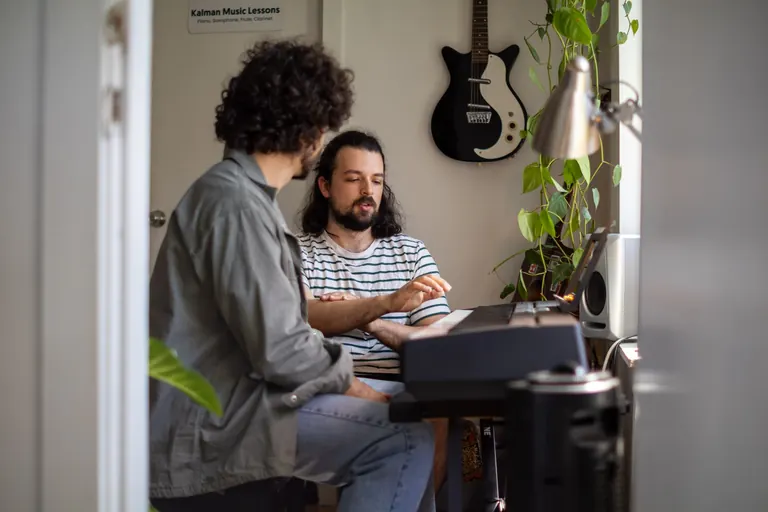
Expect the teacher to spend the first few minutes just talking — favorite songs, what made your child curious about music, whether they’ve touched an instrument before. This isn’t filler; a kid who feels comfortable learns faster. From there, the teacher gets them making sound almost immediately: a first note, a simple pattern, maybe the skeleton of a recognizable tune. The goal is for your child to walk out having done something, not just been told about it.
You’ll also get the practical foundation — how to sit or hold the instrument, and one or two tiny things to practice before next week. Don’t expect a song. Expect a spark, plus a clear sense of what comes next. And if your child is shy or slow to warm up on day one, that’s normal; teachers plan for it.
How to Keep a Kid Motivated (The Part That Really Matters)
Signing up is easy. Keeping a child playing through the inevitable “I don’t feel like practicing” weeks is the whole game. A few things reliably work.
The right teacher matters more than anything else. For kids, chemistry with the teacher is the number one predictor of whether they keep going. A teacher who’s technically brilliant but can’t make your 7-year-old laugh is the wrong teacher for your 7-year-old. If after a few lessons your child dreads them (as opposed to just grumbling about practice — that’s universal), it’s worth a conversation or a change. This is a normal, healthy thing to do.
Small, frequent practice beats marathons. Ten to fifteen minutes most days will out-perform an hour crammed in on Sunday, every time — and it’s far kinder to a kid’s willpower. Tie it to an existing routine (“after we brush teeth”) so it’s a habit, not a nightly negotiation.
Give them something to aim at. Recitals, a video for the grandparents, or simply learning a song they actually chose — a concrete goal transforms abstract practice into something that matters. The moment a child plays something a relative recognizes, the motivation math changes completely.
Let them own some of the repertoire. Kids practice music they picked far more willingly than music assigned to them. A good teacher weaves in a song the child is excited about alongside the fundamentals.
Protect the joy in year one. The first year isn’t about mastery. It’s about your child deciding, on their own, that they’re “someone who plays.” Everything else builds on that.
Why Back-to-School Is the Time to Enroll
There’s a practical reason so many families start music in the fall, and it isn’t just tradition. September resets the whole household schedule — you’re already deciding which afternoons hold which activities. Slotting music in now, while the calendar is being drawn, is far easier than trying to wedge it in mid-year. A weekly lesson that starts with the school year rides the same routine-building momentum as everything else, so the practice habit forms alongside homework rather than competing with an already-set schedule.
There’s also the runway. A child who starts in September has a real, recognizable repertoire by the winter holidays — which happens to be the first natural chance to play for family. Starting in the fall means that first “wow, listen to you” moment lands right when relatives are around to see it, and that early win is often what carries a kid through the rest of the year.
If you’re in the middle of the county, we teach throughout the area, including dedicated pages for families in Scarsdale and New Rochelle, so you can see exactly how lessons work in your town.
Frequently Asked Questions
What’s the best age for a child to start music lessons?
Most children are ready for formal one-on-one lessons between ages 6 and 8, once they can focus for about 30 minutes and follow multi-step instructions. Younger kids can absolutely be musical, but they usually do better with short, play-based sessions than a structured lesson. And there’s no upper limit — kids who start at 9, 11, or 13 often learn faster, not slower.
Which instrument is best for a young beginner?
Piano is the most forgiving starting point — it makes a good sound instantly and builds a foundation that transfers to any other instrument. Guitar is great for motivated kids but has a physically tough first month. Drums give quick wins and suit energetic kids. Voice is low-friction and wonderful for confidence. The best first instrument is usually the one your child is genuinely drawn to, and the choice isn’t permanent — skills carry over.
Are in-home or studio lessons better for kids?
Both work; the deciding factor is usually your family’s logistics. In-home lessons remove the drive-and-pack hassle that causes many kids to quit, and children often relax faster in their own space. Studio lessons offer a distraction-free music environment and access to instruments like acoustic pianos or full drum kits. Weekly consistency matters far more than the setting — pick whichever one your family will actually stick with.
How much should my child practice?
For beginners, ten to fifteen minutes most days is plenty, and it beats one long weekly session every time. Consistency builds the muscle memory that occasional cramming can’t. Tying practice to an existing routine — right after dinner or teeth-brushing — turns it into a habit instead of a nightly negotiation.
What if my child wants to quit?
First, tell the difference between dreading lessons and just grumbling about practice — the second is universal and not a red flag. If the resistance is real and ongoing, look at fit: is it the right teacher, the right instrument, the right music? Often the fix is a repertoire change, a new goal like a recital, or a teacher swap — not ending lessons entirely. Protecting the joy in the first year matters more than pushing through.
How do I get started in Westchester?
We make trying it easy and low-risk. Book a first lesson for $50 through our inquiry page, and we’ll match your child with a teacher who fits their age, instrument, and personality. You can review options and rates on our Westchester lessons pricing page first if you’d like.
The Bottom Line
Starting a child on music is one of those decisions that looks big and is actually small: pick an instrument they’re curious about, find a teacher they click with, keep lessons weekly, and protect the fun while the habit forms. Back-to-school is the natural moment to begin, because the routine is already being built and the first proud performance lands by the holidays. When you’re ready, a $50 first lesson is the easiest way to find out if it’s a fit — with in-home music lessons across Westchester and studio options throughout the county.