There is no single best piano method for kids — there are four you will actually be offered, and the right pick depends on your child’s age and how they learn. Faber Piano Adventures is the most common choice for ages 6–11. Alfred’s has the strongest options for genuine five-year-olds. Bastien covers the whole keyboard earliest. Suzuki is ear-first and needs a parent at every lesson. All four produce good pianists, and a fifth, Piano Safari, is worth knowing. What decides whether your child is still playing in two years is the teacher, not the book.
What actually separates one method from another
Nearly every difference comes down to how a child is taught to read the staff:
- Middle C position — both thumbs on middle C, hands staying put. Fast early reading; risks reading by finger number rather than pitch.
- Multi-key — five-finger patterns and chords across several keys early. Better keyboard geography, slower onto the staff.
- Intervallic / landmark — a few anchor notes, then reading by distance. Slower at first, transfers best to real repertoire.
Every modern method blends all three. That blend is what you are choosing.
Faber Piano Adventures
The series American studios reach for most often, and winner of the 2018 MTNA Frances Clark Keyboard Pedagogy Award.
Each level is four correlated books — Lesson, Theory, Performance, and Technique & Artistry — so one concept gets hit from four angles in a week. The Primer plays in Middle C and C positions but introduces new notes with varied fingerings (Middle C with fingers 1, 2 and 3 in one early piece), so children learn letter names independent of finger number.
Three entry points by age: My First Piano Adventure (5–6), Basic Piano Adventures from the Primer (6–11), and Accelerated Piano Adventures (11–17), the same ground faster.
Alfred’s Basic Piano Library and Premier Piano Course
Alfred publishes two beginner tracks parents routinely confuse.
Alfred’s Basic Piano Library is the traditional one, and its selling point is reading by recognizing intervals — 2nds, 3rds, 4ths and 5ths — rather than leaning on a fixed hand position. Within it, the Prep Course (lesson books lettered A through F) is written for children from age five, built around a young child’s attention span and small hands.
Alfred’s Premier Piano Course is newer and deliberately non-position: the word position never appears in it. Students read by landmark notes and intervals, and the theory books fold in ear training, sight-reading and improvisation.
Bastien Piano Basics and Bastien New Traditions
Published by Neil A. Kjos since 1963 and translated into 14 languages, Bastien is the veteran multi-key method. Piano Basics runs five correlated books per level — Piano, Theory, Performance, Technic, and A Line A Day Sight Reading. The Primer targets beginners of roughly 7–11 and starts in pre-staff notation; the separate Piano for the Young Beginner, Primer A and B, covers ages 5–6.
Bastien New Traditions is the all-in-one revision: Primer A stays in pre-staff notation, Primer B introduces staff notes one at a time.
The Suzuki Method
Suzuki is a philosophy that happens to have books: listen to the recordings daily, imitate, repeat, read later. Piano Volume 1 runs from Suzuki’s Twinkle Variations through Lightly Row, Cuckoo, London Bridge and Go Tell Aunt Rhody to Bach minuets.
Two things cost families more than they expect. A parent attends every lesson, takes notes and supervises daily practice — you are enrolling too. And training matters: the Suzuki Association of the Americas requires its Every Child Can! course plus instrument-specific units, with a Teaching Strategies course a prerequisite for Unit 3 since January 2025. If Suzuki is your requirement, search the SAA’s teacher directory rather than asking a general studio.
The standard criticism is fair: reading arrives late, and children often play well above what they can decode. Ask how the teacher handles it.
Quick comparison
| Method | Start age | Reading approach | Parent load | Best fit |
|---|---|---|---|---|
| Faber Piano Adventures | 5–6, 6–11, 11–17 | Position start, letter names taught independently | Moderate | Most children, especially motivated 6–9 year olds |
| Alfred’s Prep / Basic | 5+ / 7+ | Interval recognition, 2nds through 5ths | Moderate | Genuine five-year-olds; small hands, short attention |
| Alfred’s Premier | 6+ | Landmarks and intervals, non-position | Moderate | Children you want reading by pitch, not hand shape |
| Bastien | 5–6, 7–11 | Multi-key, chords early | Moderate | Kids headed for pop, worship or lead sheets |
| Suzuki | 3+ | Ear first, reading later | High — parent at every lesson | Early starters with a parent who can commit daily |
| Piano Safari | Young beginners | Rote pieces plus intervallic reading | Moderate | Kids who need to sound impressive before they can read |
Budget $8–$11 per book and two to four books per level — roughly $20–$45 a level, one or two levels a year. You do not need every book: the Lesson book is the spine, Theory the most valuable addition, and teachers often skip Performance and Technique when practice time is short.
Why the teacher matters more than the method
Every method above has produced excellent players in the hands of excellent teachers. None can hear your child. Hand tension, collapsing fingertips, a rushed pulse, the week a seven-year-old quietly stops enjoying it — those are caught by a person in the room, not printed on page 14.
A good teacher treats the method as a spine, not a script: skipping pages your child already owns, adding a pop arrangement when motivation dips, switching series when the fit is wrong. Two questions separate a teacher with a philosophy from one with a habit: which method would you use for my child, and why that one? and when will my child read music away from the piano?
Then watch a trial lesson. Six weeks in, a working method looks like this: your child names notes without counting up from C, claps a rhythm before playing it, and plays something for you unprompted. See also our guide to beginner method books, the best age to start, how to choose a piano teacher, and getting a kid started on piano.
What this looks like at Kalman Music Lessons
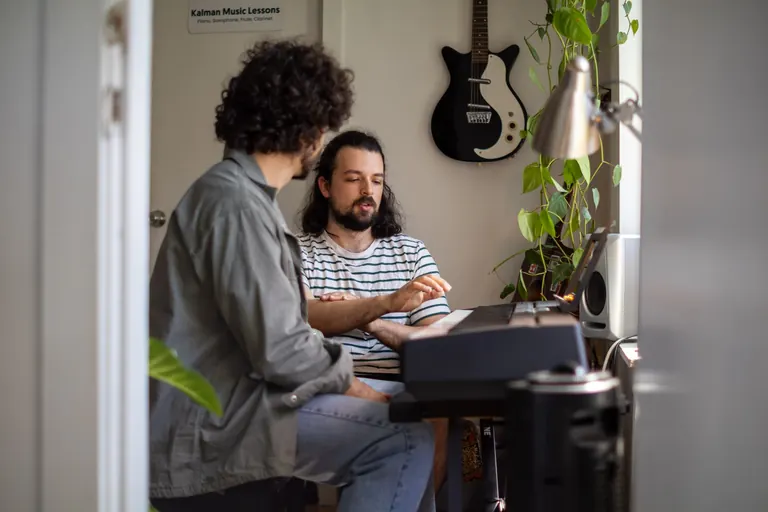
As one concrete example: Kalman Music Lessons does not standardize on a single method — individual teachers choose the books after meeting the student. It has 50+ teachers, all active performing musicians, teaching in students’ homes, at studios in Soho and Bed-Stuy, or online, across Manhattan, most of Brooklyn, western Queens and Westchester. A first lesson is $15 in the studio or $50 at your home; ongoing lessons start at $50 on a 10-pack, from $60 in-home, or memberships from $99 a month, with no contract (full rates). Founder Tal Kalman holds an M.M. from the Manhattan School of Music, and group classes launch fall 2026. See the kids’ program or piano lessons.
It is not the right answer for everyone. It is not a Suzuki studio, so a family set on registered Suzuki training should use the SAA directory. A child on a conservatory pre-college or graded-exam track (RCM, ABRSM) wants a teacher who runs that syllabus every year. And an independent teacher your nine-year-old can walk to alone buys logistics no studio can match.
FAQ
What is the best piano method for a 5-year-old? Faber’s My First Piano Adventure, Alfred’s Prep Course Book A, or Bastien’s Piano for the Young Beginner Primer A. All three are written for pre-readers with short attention spans and small hands. Suzuki also works at five if a parent attends every lesson.
Is Suzuki better than traditional methods? Neither is better. Suzuki builds ear, memory and tone early and demands heavy parent involvement; traditional methods build reading fluency earlier and ask less of you.
How do I know the method isn’t working? After several months your child still reads by finger number rather than by note, or practice has become a daily argument. Both are a conversation with the teacher — an app won’t fix either (here’s why).