The right guitar teacher in Harlem is an active working musician who teaches you personally every week, follows a concrete plan built around your goals, and prices lessons transparently. Vet candidates with a few direct questions, compare rates against published NYC pricing, and use a low-cost trial lesson to test the fit before committing to anything.
What Should You Look For in a Guitar Teacher?
Three things predict whether lessons will work: the teacher performs, the teacher plans, and the teacher shows up — the same teacher, every week. Everything else, from studio decor to the brand of guitar on the wall, matters far less.
An active performer teaches differently than someone who stopped gigging years ago. They demonstrate instead of describing, they know how songs actually get played on a bandstand, and they can show you the gap between what’s on the page and what audiences hear. Every teacher on our 24-teacher faculty is a working New York musician, and the bios are public, so you can see exactly who you’d be studying with before you commit.
A teaching plan matters just as much. Ask any prospective teacher what your first eight weeks will look like; a good one answers specifically — which chords, what rhythm work, a first song, how practice will be structured. “We’ll see how it goes” is not a plan.
Finally, insist on the same teacher every week. Guitar progress compounds: this week’s lesson builds on what last week’s revealed about your hands, your ear, and your practice habits. A rotating cast of substitutes resets that clock every time.
In-Home or Studio: Which Works Better in Harlem?
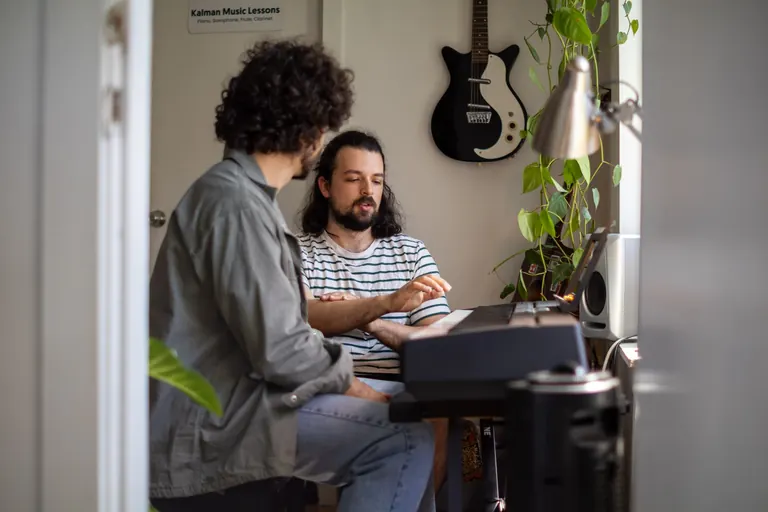
Harlem is well suited to in-home lessons. Brownstone blocks in West Harlem and Hamilton Heights have living rooms with space for two chairs and a music stand, and apartments along the 125th Street corridor work fine too — guitar needs less room than almost any other instrument. In-home lessons start at $60, and the teacher handles the commute, not you.
In-home is especially practical for families. Siblings can take back-to-back lessons without anyone leaving the house, and some households pair guitar for one child with piano lessons in Harlem for another. Nobody wrangles a stroller or a gig bag across town on a school night.
If home is too distracting, studio lessons run at our Manhattan and Brooklyn locations, and online lessons are a third option that suits guitar better than most people expect — a webcam angled at the fretboard shows a teacher everything they need. Many students settle into a mix, defaulting to one format and using the other when the week demands it.
Don’t own a guitar yet? Rentals are available — guitars along with keyboards, woodwinds, and brass — so you can start lessons before spending money on an instrument you haven’t learned to evaluate.
What Questions Should You Ask Before Booking?
A ten-minute conversation before you book tells you more than any website. Ask these directly:
- Where do you perform, and how recently did you last play out?
- Will I have the same teacher every single week?
- What will my first two months look like, concretely?
- Do you teach the styles I actually want to play?
- Is there a registration fee, contract, or semester commitment?
- What happens when I need to reschedule?
Listen for specificity. A teacher who answers with real venues, a real sequence of skills, and clear policies has thought carefully about teaching — vague answers on the phone tend to become vague lessons in your living room. Good teachers also ask you questions back: about your goals, your schedule, and the music you already love.
Which Red Flags Should Make You Keep Looking?
Registration fees are the first. A fee to join a roster buys you no instruction, and reputable programs — ours included — charge nothing to register. Semester lock-ins are a close second: guitar progress doesn’t follow an academic calendar, and a program confident in its teaching lets you start any week and continue because you want to, not because a contract says so.
Be wary of any school that won’t tell you who your teacher will be, or that treats teachers as interchangeable parts. Be equally wary of a teacher with no performing life at all — you’re learning an instrument that lives on stages and at jam sessions, and your teacher should too.
Opaque pricing is a red flag in itself. If you have to sit through a sales call to learn the rate, the rate is not the selling point.
What Does a Fair Price Look Like in NYC?
Compare prices for the same lesson length, format and payment commitment. Our pricing page shows single lessons and prepaid packages separately. A 30-minute studio lesson is $65 individually, or $50 per lesson when you pay $500 for a ten-pack; a 30-minute NYC home lesson is $75 individually, or $60 per lesson on a $600 ten-pack. NYC studio memberships are a separate option, with both monthly payments and a full-year prepaid price shown.
Use those figures as a benchmark when you compare. A Harlem teacher charging much more should be able to explain what the difference buys you; one charging dramatically less is often economizing on preparation, consistency, or experience.
Reviews help calibrate too. We hold 5.0 stars across 50+ Google reviews, and whoever you’re considering, read their recent reviews for mentions of the things this guide covers: planning, consistency, and communication.
How Can a First Lesson Help You Choose?
A first lesson lets you hear the teacher explain, ask questions and see how the pace suits you. The first 30 minutes cost $15 at an NYC studio or $50 at your home. Ask about online introductory pricing. You do not need to buy an ongoing package for that first lesson.
Use the trial actively. Bring a song you want to learn, say how much you can realistically practice, and watch whether the teacher adjusts to you or runs a script. By the end, you should be able to describe what your next four lessons would cover.
Trials are open to all ages — kids 5 and up and adult complete beginners alike. Logistics are simple: text us between 9am and 9pm and we reply within minutes, and a same-week start is typical. If you’re in the neighborhood, start with our Harlem guitar lessons page; for the citywide program, see the guitar lessons overview.
Frequently Asked Questions
Do I need to own a guitar before my first lesson?
No. Rentals are available, and your teacher can advise on sizing and setup before you buy anything. For young kids especially, it’s worth waiting until a teacher has seen their hands before choosing an instrument size.
How quickly can I start after choosing a teacher?
Usually within the week. There’s no semester system — you can start any week of the year — and a same-week first lesson is typical. Text us between 9am and 9pm and you’ll generally hear back within minutes.
Are online guitar lessons a real alternative in Harlem?
Yes. Guitar translates well to video: a well-placed camera shows the fretboard and both hands clearly. Some students use online as their primary format, while others keep it as a backup for weeks when meeting in person isn’t possible.