Pick one activity that meets on a repeating schedule with the same people, and go every week for three months. That’s the whole method. The best-known estimate of how long adult friendship takes — Jeffrey Hall’s study in the Journal of Social and Personal Relationships — puts it at roughly 50 hours of shared time before an acquaintance becomes a casual friend, about 90 before a friend, and 200-plus before a close one. A weekly group accumulates those hours quietly; a calendar full of one-off events never does. In New York that means no-audition choirs, drum circles, rec leagues, run clubs, and any class with a fixed cohort. Private music lessons, despite what a music school might prefer to tell you, are not on the list.
Why don’t one-off events work?
Because the hours don’t stack against the same faces. A different meetup every Thursday can produce fifty pleasant conversations and zero friends: friendship is built from repetition, not from volume of introductions. Hall’s data also found that hours logged at work counted for less than hours spent genuinely hanging out, which is why “I have work friends” so often coexists with feeling like you don’t really know anyone in your own city.
Two filters follow. Choose something with a roster — a season, a term, a rehearsal cycle — so the same people come back. And choose something you’d attend even if nobody spoke to you, because those are the weeks that break the streak.
Are music lessons a good way to meet people?
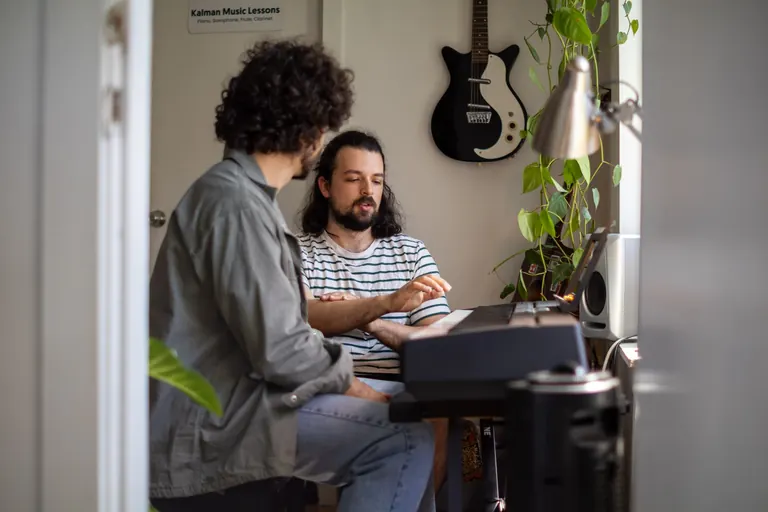
No — worth being blunt, because it’s the most common mistake people make when they take up something creative to fix a social problem. A private lesson puts you in a room with exactly one other person, who is a professional being paid to be there. Excellent use of an hour. Not a social hour. Adults who take up an instrument mainly to widen their circle tend to end up with a hobby they enjoy and a social calendar that hasn’t changed — a fine outcome, just not the one they were buying.
Take lessons because you want to play; our complete guide to adult music lessons in NYC covers cost, format and where to start. Just don’t buy them expecting a social life attached.
Which formats in NYC actually work?
Roughly ranked by how easy they are to walk into alone:
Run clubs. The lowest-friction option in the city, and the cheapest. New York Road Runners’ Open Run is free: community-led weekly runs in neighborhood parks in and around the five boroughs, open to runners and walkers of any pace.
Rec leagues. ZogSports and similar coed recreational leagues let you sign up solo and be placed on a team, which solves the hardest part: you arrive already belonging to a group with an obvious reason to talk. Expect a per-season fee; check the current number on the league’s own site.
No-audition community choirs. One of the few activities where a complete beginner is useful on night one, and rehearsal is weekly by definition.
Fixed-cohort classes — pottery, improv, cooking, drawing, music. Cohort is the operative word: a drop-in class with a new crowd each week is a one-off event wearing a class’s clothes. We compared them on cost and time-to-first-win in music vs. other hobbies for adults.
Jam nights and open mics. Real communities form around these, but they reward people who already play. Phase two, not phase one.
Volunteering. Overlooked, free, and a recurring shift beats a one-day event for the same reason as everything else here.
If meeting people is the actual goal and music is incidental, a free run club or a rec league will get you there faster than anything we sell.
Which music formats are genuinely social?
Only the group ones, and not all of those equally. Our fall 2026 group classes split cleanly in two.
Genuinely social: the no-audition community choir, where the music forces you to listen to the person beside you; the drum circle, where the entire activity is responding to other people in real time; and the songwriting workshop, a small room where people share unfinished drafts, which builds trust faster than small talk.
Less social than they look: mindfulness in music and music appreciation are both listening-based. You’ll be in a room with people, but quietly. Pick those for the subject, not the company.
The numbers are checkable: free on Pro and Elite memberships, $25 for current students and their plus-ones, $35 otherwise, or $60 a month for a Class Pass covering all of them. No semester contracts, so a bad fit costs you one class.
What if walking in alone feels impossible?
Choose the format where the activity does the talking. You sing before you introduce yourself; nobody picks out one mistake among twenty drums; on a group run you’re side by side instead of face to face. Each swaps being interesting on demand for a shared task. Commit to four sessions before judging.
FAQ
How long until this actually works? Think in seasons, not evenings. Using the 50-hour figure as a yardstick, a two-hour weekly class clears it in about six months. One caveat: those hours count per person, and in a room of fifteen you aren’t logging fifty with anyone. What speeds it up is whoever you sit next to every week, or stays for a drink afterward.
Is it easier in Manhattan or Brooklyn? Neither. Proximity matters far more: pick something within about 25 minutes of home or work. Commute length, not borough, is what kills attendance in month two.
I’m in my 40s. Is it too late? No. Beginner-level adult groups exist because plenty of people start late, and being a beginner next to other beginners is its own bond. More on timing in why your 30s are a good time to start a musical hobby.
Should I bring a friend? More comfortable, less effective — pairs talk mostly to each other. If you bring someone, agree in advance to split up partway through.
Do I need musical experience for a choir or drum circle? None. Both are built so the simplest part is a real, useful role, and both teach by ear rather than from sheet music.