You sit in a circle with a hand drum, a facilitator sets a pulse simple enough for everyone to hold, and layers are added by call-and-response until the room is producing a groove none of you could play alone. That’s the whole mechanism — and it works with complete beginners, which is the point.
Do you need rhythm to join?
No. You need a heartbeat and a walking pace, which are both rhythm. Facilitated circles are engineered so the simplest part — a steady pulse on the downbeat — is a full, legitimate role. The interlocking parts stack on top of whoever wants them. Nobody can tell whose hit was late in a circle of twenty drums, which is exactly why beginners relax fast.
What do you play?
Hand percussion: djembes and congas for the core groove, frame drums, shakers and bells for people who want to start smaller. A good circle provides the instruments — you bring hands.
Why do people find it so addictive?
Three honest reasons. It’s physical — an hour of drumming is real exercise wearing a disguise. It’s attentional — holding your part while listening to everyone else’s evicts whatever you were ruminating about more thoroughly than most meditation. And it’s social in a way almost nothing else is: the entire activity is listening to other people.
Drum circle vs. drum lessons
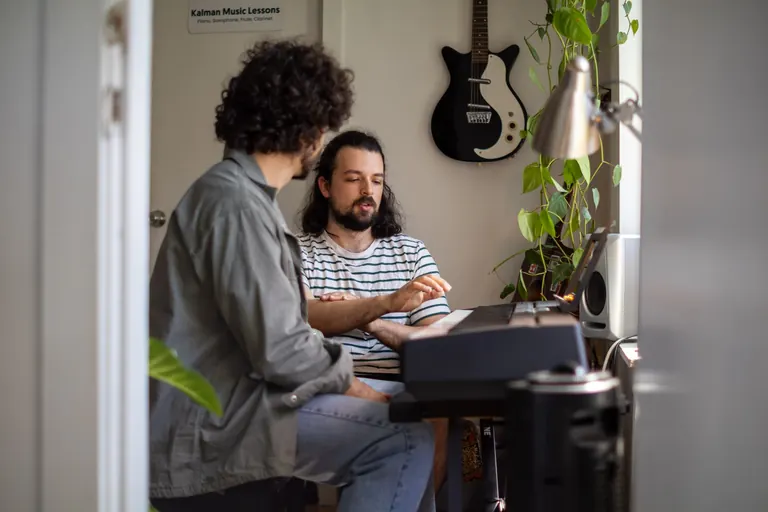
A circle teaches groove, listening and time — in a group, by ear. Lessons teach technique, independence and a kit — one-on-one. They feed each other: circles make lesson students musical, lessons make circle players capable. Start with whichever sounds like more fun; that instinct is usually right.
Where to try one in NYC
Kalman Music Lessons runs a beginner-friendly drum circle in NYC starting fall 2026 — drums provided, no experience needed, free on Pro and Elite memberships and $35 for everyone else. If the kit is calling you instead, drum lessons start at $15 for a first lesson.