You do not need music theory to write a song. You need a phrase you mean, a structure you can borrow, and permission to finish something imperfect. Most of the songs you love were written by ear, by people following those three rules without calling them rules.
Start with the phrase, not the music
Every song you’ve ever remembered started life as a phrase with a temperature: something said in an argument, a line from your notes app, six words you’d put on a T-shirt. Write down ten. One of them will feel heavier than the others. That’s your title, and probably your chorus.
Steal a skeleton
Song structure is public property. Verse–chorus–verse–chorus–bridge–chorus has carried thousands of hits and it will carry yours. Take a song you love, map its shape — where it repeats, where it lifts — and pour your phrase into that mold. This isn’t cheating; it’s how every songwriter learned, including the ones you’d steal from.
Three chords are a career
If you play a little: G, C and D (or their cousins) have powered decades of songwriting. If you play nothing: hum the melody over a recorded loop, or write a cappella and let someone put chords under it later. Melody and lyric are the song; chords are the furniture.
Finish ugly
The single biggest difference between people who write songs and people who “could never” is that songwriters finish bad drafts. Your first song will be derivative and structurally lumpy. Finish it anyway — the second one is better, and the fifth one is yours.
The fast lane: write in a room
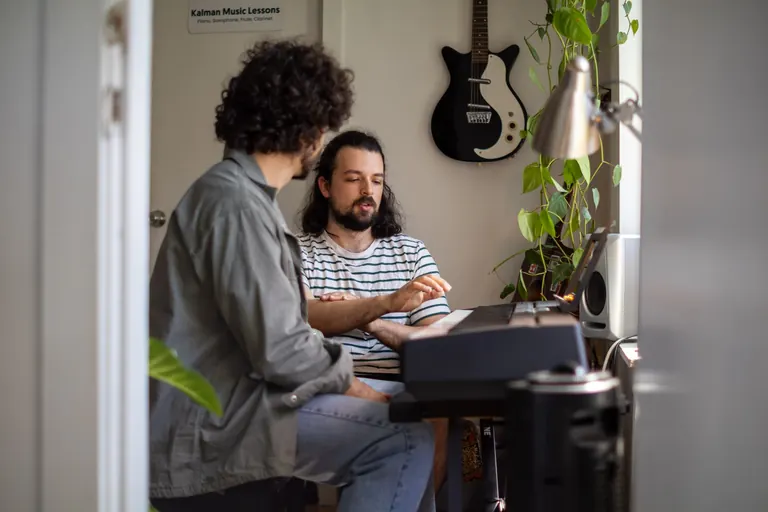
Songs improve at the speed of feedback. A workshop gives you deadlines, borrowed chords, and a room that tells you which line landed — which is months of solo guessing, skipped. Kalman Music Lessons runs a singer-songwriter workshop in NYC starting fall 2026, built for complete beginners: no theory, no instrument, no experience. Free on Pro/Elite memberships, $35 for everyone else.