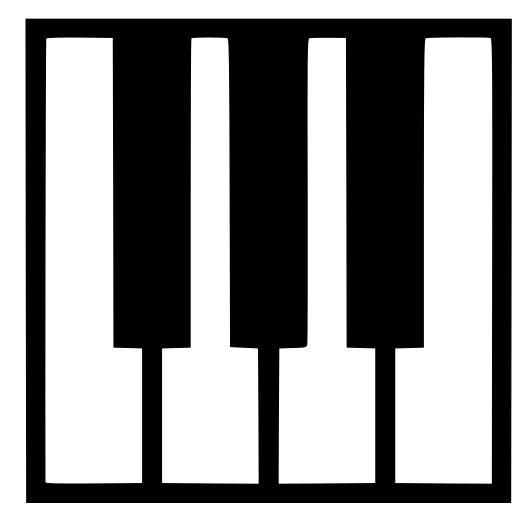
Kalman Music Lessons’ beginner piano guide starts with a visual landmark: C is the white key immediately to the left of a group of two black keys. Find that group anywhere on the keyboard, then look to its left. The same pattern repeats across the instrument.
Our piano lessons are available at NYC studios, at home in our service area and online. You can try the note-finding activity below on a piano or keyboard before your first lesson.
Find the white keys from C
Starting at C, move right through the white keys: C, D, E, F, G, A, B, then C again. The alphabet wraps after G; it does not continue to H.
Look for the group of three black keys as a second landmark. F is immediately to its left. Finding both C and F helps you orient yourself without counting all the way from the end of the keyboard.
A standard acoustic piano has 88 keys, beginning on a low A and ending on a high C. Smaller keyboards use the same repeating note pattern across a shorter range.
Name the black keys
Each black key can be named as a sharp of the white note to its left or a flat of the white note to its right:
| Between these white keys | Sharp name | Flat name |
|---|---|---|
| C and D | C sharp | D flat |
| D and E | D sharp | E flat |
| F and G | F sharp | G flat |
| G and A | G sharp | A flat |
| A and B | A sharp | B flat |
There is no black key between E and F or between B and C. A sharp raises a note by one semitone; a flat lowers it by one semitone. Depending on the musical context, a sharp or flat can also refer to a white key—for example, E sharp is played on the same piano key as F.
Try a three-step keyboard exercise
First, find three different groups of two black keys and play the C beside each group. Listen to how the note sounds higher as you move right.
Second, choose one C and play C–D–E–F–G slowly, naming each note. Return toward C without increasing speed.
Third, find the next C above your starting note. The distance between these two Cs is an octave. Try the same idea with two Fs.
These are orientation tasks. Stop to locate the pattern rather than racing along the keyboard. A teacher can help connect the landmarks to reading and a short piece.
Understand finger numbers
On both hands, the thumb is finger 1, index 2, middle 3, ring 4 and little finger 5. The hands face different directions at the keyboard, but the numbering does not reverse.
A teacher chooses fingering for the passage and your hand. Note names and finger numbers describe different things; do not permanently assign a particular finger to every C or D.
Common questions
Are all black keys sharps and all white keys natural notes?
White keys are named A through G, and black keys commonly have sharp or flat names. Musical spelling can also assign sharp or flat names to white keys, so key color is a starting landmark rather than the full rule.
Do I need all 88 keys for this exercise?
No. A smaller keyboard includes the same two-black-key and three-black-key patterns. For lessons, tell Kalman Music Lessons your instrument model so the teacher can assess its range and touch. See our Sunset Park keyboard setup guide for an equipment checklist that is useful wherever you live.