If you have ever been told you “can’t sing,” this guide is for you. The short, honest answer is that almost everyone can learn to sing — singing is a trainable physical skill, not a fixed gift you either have or don’t. The people who sing well usually practiced, got feedback, and stuck with it, not because they were born different.
The Honest Short Answer
Can anyone learn to sing? For all practical purposes, yes. Singing is a coordination of breath, vocal folds, and hearing — three systems that respond to training the same way any muscle or motor skill does. Very few people have a genuine, permanent inability to match or perceive pitch. Everyone else is somewhere on a learning curve, and where you land depends far more on practice than on genetics.
This matters because the belief that you “can’t sing” is often the only real obstacle. People who think they are hopeless usually stop trying, which guarantees they never improve. The truth is more encouraging: you are not stuck. You simply have not trained yet.
That said, “anyone can learn to sing” does not mean everyone becomes a professional performer with a three-octave range. It means nearly everyone can learn to sing in tune, carry a tune confidently, and enjoy singing — which is what most beginners actually want.
Why So Many People Think They Can’t Sing
Most “I can’t sing” stories trace back to a handful of common causes, and almost none of them are about a true lack of ability.
- A discouraging comment years ago. A relative, a choir director, or a classmate said something offhand, and it stuck. One negative moment can end someone’s singing life for decades.
- No training, then judging the untrained result. People compare their first, coached-by-no-one attempts to recorded, produced, professional voices and conclude they have failed. That comparison is unfair.
- Hearing your own voice. Your voice sounds different to you internally than it does on a recording, because bone conduction adds warmth and low frequencies. The recorded version can feel jarring, which people misread as “I sound bad.”
- Singing in the wrong range. Trying to match a song in a key that is too high or too low for you produces a strained, off sound. That is a key problem, not a talent problem.
- Confusing pitch-matching with a permanent condition. Struggling to hit a note is normal for a beginner. It usually resolves quickly with ear-and-voice practice.
Notice that every item on this list is fixable. None of them means your voice is broken.
What “Tone Deafness” Actually Is (and Isn’t)
“Tone deaf” is one of the most misused phrases in music. The real clinical condition is called amusia, and it is rare — research generally estimates it affects only a small percentage of the population, and true congenital amusia is rarer still. People with genuine amusia have difficulty perceiving differences in pitch, not just producing them.
Here is the key distinction: most people who call themselves tone deaf can hear perfectly well that a note is wrong. If you can tell when a singer on the radio is off, or when a note sounds “sour,” you almost certainly do not have amusia. What you have is an untrained connection between your ear and your voice — and that connection is exactly what vocal practice builds.
| Belief | Reality |
|---|---|
| ”I’m tone deaf.” | True tone deafness (amusia) is rare; most self-described “tone deaf” people hear pitch fine. |
| ”You either can sing or you can’t.” | Singing is a skill on a spectrum that responds to training, like any motor skill. |
| ”My voice just sounds bad.” | Often it’s the wrong key, no breath support, or hearing your own recording — all fixable. |
| ”It’s too late to start.” | The voice can be trained at any age; adults learn quickly with focused practice. |
| ”I need natural talent.” | Talent may speed early progress, but consistent practice matters far more long-term. |
If you can hum a note and adjust it up or down until it “feels right,” your pitch perception is working. The rest is training.
What Actually Determines Singing Ability
If it isn’t a magic gift, what does separate confident singers from beginners? A few concrete, trainable factors.
- Breath support. Steady airflow from the diaphragm powers a stable tone. Weak or held breath produces a shaky, thin, or straining sound.
- Pitch matching (audiation). The ability to hear a note in your head and reproduce it with your voice. This is a feedback loop your brain refines with repetition.
- Vocal cord coordination. The fine muscles controlling your vocal folds learn to find and hold pitches accurately over time.
- Range and register awareness. Knowing where your comfortable range sits, and how to move between chest voice and head voice without cracking.
- Ear training. Recognizing intervals and staying anchored to a key so you don’t drift flat or sharp.
- Confidence and relaxation. Tension in the jaw, tongue, neck, and shoulders sabotages tone. Relaxed singers sound better instantly.
Every one of these improves with practice. Not one of them is fixed at birth. That is the whole reason the answer to “can anyone learn to sing” is yes.
A Realistic Starting Path for Beginners
You don’t need a studio, expensive gear, or a “born singer” voice to start. You need a simple, repeatable routine. Here is a realistic first month.
- Warm up gently (5 minutes). Lip trills (blowing a raspberry through relaxed lips) and quiet humming wake up your voice without strain. Do them daily.
- Learn to breathe low. Put a hand on your belly. Breathe so your hand moves out, not your shoulders up. Sing a sustained “ah” and try to keep the tone steady until you run out of air.
- Find your comfortable range. Sing your favorite song and notice where it feels strained. Move it up or down a few steps until it feels easy. Singing in the right key changes everything.
- Practice matching pitch. Play a single note on a piano or a free tuner app, hum it, then sing it on “ah.” Use the app’s needle as feedback. This directly trains the ear-to-voice loop.
- Record yourself. It feels awkward, but a recording is honest feedback. Listen for pitch and steadiness, not tone quality at first. You will get used to your recorded voice quickly.
- Sing a little every day. Fifteen focused minutes daily beats two hours once a week. Consistency is what rewires the coordination.
Give this four to six weeks before judging your progress. Most beginners are genuinely surprised by how much steadier and more in-tune they sound after even a month of daily practice.
When a Teacher Actually Helps
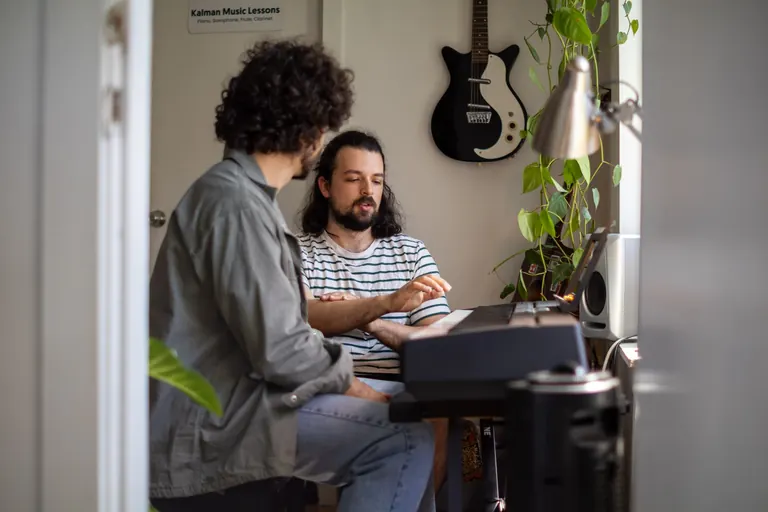
You can make real progress alone, but a good voice teacher accelerates it and prevents bad habits from setting in. Here is when working with one is worth it.
- You keep cracking or straining on higher notes and can’t tell why. A teacher spots register transitions and tension you can’t hear yourself.
- You genuinely can’t match pitch yet. Targeted ear-and-voice exercises, guided in real time, fix this far faster than solo trial and error.
- You want to sing specific repertoire — musical theater, pop, classical — each has technique a teacher can shortcut for you.
- You’re overthinking your recorded voice and losing motivation. An outside ear gives you an accurate, encouraging baseline.
The biggest thing a teacher provides is real-time feedback. When you sing slightly flat, they hear it instantly and adjust you before the wrong habit sets in — something no app fully replaces. If you’re exploring lessons, our voice lessons pair you with an instructor who meets you at your exact starting point, whether that’s “I’ve never sung” or “I sing in the shower and want more.”
If you’re weighing singing against picking up an instrument, learning voice is uniquely portable — your instrument is always with you. Some students combine it with piano for accompaniment and ear training, or with guitar so they can play and sing together. Any of these builds the same underlying musicianship.
Realistic Expectations by Timeline
Progress is real but gradual. Rough, honest expectations for a beginner practicing consistently:
- Weeks 1–4: Better breath control, less strain, first improvements in pitch matching. You start to trust your voice a little.
- Months 2–3: You can carry simple songs in tune, in your comfortable key, with more confidence.
- Months 4–6: Expanded range, smoother transitions between registers, and the ability to sing along reliably in group settings.
- Beyond 6 months: With continued work — and ideally some coaching — style, tone, and control keep developing for years. There is no ceiling you hit early.
The people who “can’t sing” are almost always the people who quit in week one. The ones who can sing simply kept going.
Frequently Asked Questions
Can anyone really learn to sing, or is it a natural gift?
Almost anyone can learn to sing. Singing is a trainable skill built on breath, pitch matching, and ear-voice coordination — all of which improve with practice. Natural talent can make early progress faster, but consistent, focused practice matters far more over time. Unless you have genuine, rare amusia, you can learn to sing in tune.
How do I know if I’m actually tone deaf?
If you can tell when a singer on the radio is off-key, or when a note sounds wrong, you are almost certainly not tone deaf. True tone deafness (amusia) is a rare condition affecting pitch perception, and most people who call themselves tone deaf simply have an untrained ear-to-voice connection — which practice fixes.
Why does my singing voice sound bad to me?
Often it’s not that your voice is bad — it’s one of three fixable things: you’re singing in a key that’s too high or low for you, you lack breath support so the tone is shaky, or you’re reacting to hearing your own recorded voice, which naturally sounds different from what you hear internally. All three improve quickly with practice.
Is it too late to learn to sing as an adult?
No. The voice can be trained at essentially any age, and adults often learn quickly because they can focus, follow instructions, and practice deliberately. You may need more warm-up and gentle care with your voice than a teenager, but there is no age cutoff for learning to sing well.
How long does it take to learn to sing?
With about 15 focused minutes of daily practice, most beginners notice steadier tone and better pitch within four to six weeks. Carrying simple songs confidently usually comes within two to three months, and range and control keep developing for years — especially with a teacher’s feedback to guide you.
Ready to Hear What Your Voice Can Do?
The best way to find out whether you can sing is to try — with real guidance instead of guesswork. Book a $15 trial voice lesson through our inquiry page and get honest, encouraging feedback on where you’re starting from. You can also see our full pricing first. Nearly everyone can learn to sing, and there’s no better time to prove it to yourself than now.